

Encyclopedia of Shia Teachings” Unveiled with Global Elites Present
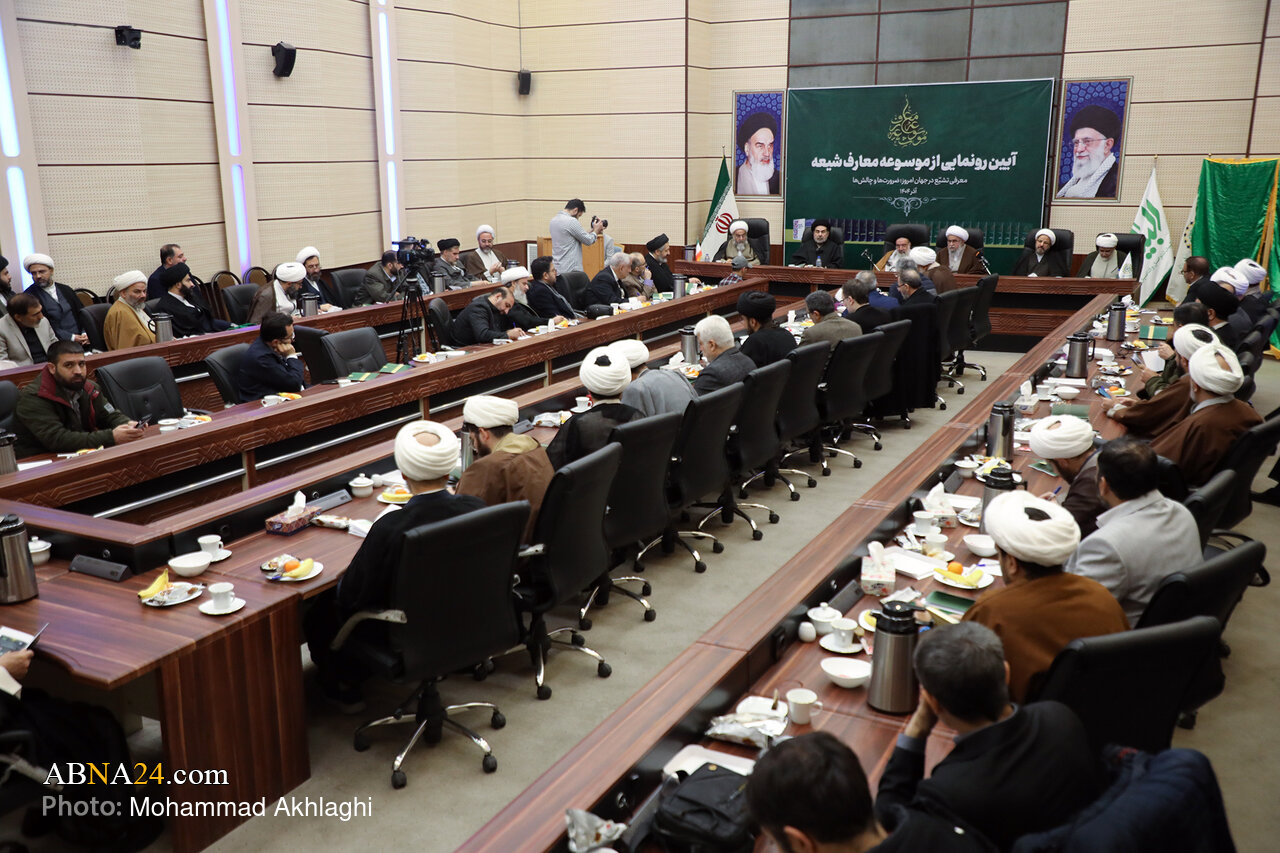
“Encyclopedia of Shia Teachings” Unveiled with Global Elites Present; A New Movement in Encyclopedism for Civilizational Dialogue Gathering of Domestic and International Elites at the Ahlul Bayt World Assembly A magnificent ceremony marking the unveiling of the “Encyclopedia of Shia Teachings” and a strategic scientific session titled “Introducing Shiism in the Contemporary World: Necessities and […]
“Encyclopedia of Shia Teachings” Unveiled with Global Elites Present; A New Movement in Encyclopedism for Civilizational Dialogue
Gathering of Domestic and International Elites at the Ahlul Bayt World Assembly
A magnificent ceremony marking the unveiling of the “Encyclopedia of Shia Teachings” and a strategic scientific session titled “Introducing Shiism in the Contemporary World: Necessities and Challenges” was held on Thursday, December 18, 2025 (Azar 27, 1404), at the main hall of the Ahlul Bayt World Assembly in Qom. This grand gathering hosted Ayatollah Seyyed Ahmad Khatami, member of the Guardian Council and the Assembly of Experts; Hojjat al-Islam wal-Muslimin Maulana Kalbe Jawad, General Secretary of the Majlis Ulama-e-Hind; and a large number of top-tier seminary and university professors, distinguished researchers, and scientific and cultural figures from various countries including India, Iraq, Lebanon, and Turkey.
The program was organized with the participation and cooperation of multiple scientific institutions, including the Ahlul Bayt Teachings Institute, the Islamic Culture and Communication Organization, the Seminary Management Center, and the Institute for Reviving Islamic Civilization Heritage. This collaboration demonstrated the collective determination of Shia scientific institutions to present a coherent exposition of the teachings of the Ahlul Bayt (pbut).
Emphasis on Rationality, Reasoning, and a Comprehensive Worldview as Epistemic Foundations
Ayatollah Reza Ramazani, Secretary-General of the Ahlul Bayt World Assembly, in a detailed speech, described this encyclopedia as more than just a book, calling it “the expression of a worldview” and the result of the valuable work of a group of specialists in every field. Referencing numerous verses of the Holy Quran emphasizing reasoning, he noted:
“About three hundred verses in the Holy Quran emphasize reasoning and thinking. God says in Surah Al-Anbiya, verse 10: ‘We have certainly sent down to you a Book in which is your mention. Then will you not reason?’ The ruling spirit over the teachings of the Ahlul Bayt (pbut) is the spirit of rationality, spirituality, and moderation, and this must be manifested in introducing Shiism to the world.”
He also emphasized the necessity of problem-oriented, collective research responsive to contemporary doubts, warning that research without critique loses its dynamism.
Elucidation of Two Key Axes: “Mercy” and “Resistance” in the Ahlul Bayt Discourse
In another part of his speech, Ayatollah Ramazani explained the theoretical framework for introducing the School of Ahlul Bayt (pbut), basing the comprehensive introduction of this school on the two axes of “Mercy and Resistance.” He stated:
“The discourse of the Ahlul Bayt is the discourse of just peace. Resistance finds meaning under mercy, and both aim to expand the dissemination of Divine mercy. Without resistance, systems of intellectual and political domination would complete their hegemony.”
He also pointed to challenges such as “systemic Shia-phobia, soft war, and cultural assault,” emphasizing the need for intelligence in explaining these teachings.
Mediatization and Overcoming Field Obstacles; Priority of Cyberspace
Dr. Ahmad Vaezi, Head of the Islamic Propagation Office, analyzing global conditions, described cyberspace and media as “the most open and effective field of action” for introducing Shiism. He said:
“This space does not require physical presence, is not dependent on a specific location, and can create a global impact.”
In contrast, he considered field actions reliant on official institutions to face serious obstacles such as international sanctions, legal restrictions, and the rise of right-wing and anti-Iranian currents in the West. Dr. Vaezi emphasized that the Encyclopedia is “the first link in a cycle” and must be completed and promoted through the extensive production of media content such as podcasts, animations, and critique sessions.
Encyclopedism: A Strategy for Institutionalization and Global Role-Playing of Shiism
Dr. Mohsen Alviri, Director of the History Department at Baqir al-Olum University (as), presented a historical analysis of the role of encyclopedias in human intellectual developments—from 18th-century European encyclopedists to the Islamic Encyclopedia—calling the present era the “Century of Encyclopedism.” Referring to books such as “The Shia Revival,” he noted that after the Islamic Revolution and regional developments, Shias have transformed from a little-known minority to influential actors on the global stage. Dr. Alviri warned:
“We must not suffice with reductionist views that consider the role of Shias as merely political and regional. Shiism has an unparalleled capacity to answer the epistemic, ethical, and spiritual challenges of today’s world.”
He called for a “new movement in encyclopedism” similar to the Enlightenment movement in Europe.
Necessity of Compiling Encyclopedias for Diverse Audiences and New Conceptualizations
Continuing with ten policy recommendations, Dr. Alviri emphasized “audience typology,” stating:
“We need encyclopedias for different layers of audiences: from Imami Shias to followers of other Islamic schools, Abrahamic religions, and ultimately all human beings. Distinct principles and strategies are required for each.”
He emphasized the need for “conceptualization” for core Shia beliefs using intra-religious terminology (such as Ashura and Resistance, which have now entered international literature) and leveraging the vast capacity of diaspora Shias worldwide.
Introducing the Encyclopedia: From Content Comprehensiveness to Rigorous Compilation Process
Hojjat al-Islam wal-Muslimin Dr. Mohammad Taqi Subhani, President of the Al-Bayan Institute for Communication and Origination (Al-Bayan lil-Tawasul wa al-Ta’sil), elaborated on the goals, features, and plans of this massive project. He stated the goal of the Al-Bayan Institute is “introducing Shiism as Shia scholars know it, without ‘Shiatization’ or polemics, focusing on communication (Tawasul) and authentication (Ta’sil).”
He listed the features of the Encyclopedia as follows:
- Comprehensiveness (from doctrinal foundations to contemporary issues such as human rights, peace, environment, Shia geopolitics, and the introduction of the clergy).
- Specialization-centered (utilizing top-tier authors in each field).
- Collective research and multi-stage critique (some volumes were rewritten three times).
- Fluent language for the educated non-specialist audience, while maintaining full citation.
Future Plans: Translation into Ten Languages and Multimedia Content Production
The President of the International Imamat Foundation announced future plans:
“Translation of this collection into at least ten living languages of the world (Arabic, English, Urdu, Turkish, Russian, etc.) is underway in cooperation with reputable international publishers. Also, the production of podcasts, animations, and other media formats to disseminate the content is on the agenda.”
He announced that after the unveiling, specialized critique sessions for each volume with the presence of experts in that field will be held to provide a basis for completing and upgrading the work.
Shiism as a Civilization-Building Issue and Declaration of Scientific Stance
Dr. Mohammad Ali Rabbani, Director General of Scientific and Academic Cooperation at the Islamic Culture and Communication Organization, considered the unveiling of this encyclopedia as “declaring a scientific stance.” He emphasized:
“Introducing Shiism in today’s world is an epistemic, civilizational, and civilization-building issue. This work shows that Shiism, with its rich epistemic backing, is ready to present its teachings in an organized and rational manner and enter into constructive dialogue with other intellectual traditions of the world.”
Message of Hope and Unity from the East; The Historical Role of Ahlul Bayt (pbut) in Scientific Progress
Hojjat al-Islam wal-Muslimin Seyyed Kalbe Jawad Naqvi, General Secretary of the Majlis Ulama-e-Hind, spoke with a historical and hopeful tone:
“The people of the world do not know that whatever they have in science and civilization is from the blessing of the Ahlul Bayt (pbut). When Europe was in the darkness of ignorance, Imam Sadiq (pbuh) established a university in Medina where all the sciences of the time were taught. The Islamic Revolution of Iran and the sacred existence of Imam Khomeini (RA) have also brought many blessings to the oppressed of the world. This encyclopedia speaks of these scientific miracles, and the cry of these teachings must reach everyone from the North Pole to the South.”
Major Proposals: Forming a Strategic Think Tank and Institutional Synergy
During the session, important strategic proposals were raised. Dr. Subhani proposed that “The Ahlul Bayt World Assembly host a strategic think tank for the development of Shia teachings” to identify and answer global needs in this field. Ayatollah Ramazani also emphasized “institutional synergy and management of parallel research” and noted the necessity of a “specific custodian” to organize scientific efforts in the field of Shia studies.
Conclusion and Symbolic Unveiling of a Scientific Treasure
At the conclusion of this fruitful ceremony, in the presence of Ayatollah Seyyed Ahmad Khatami and Hojjat al-Islam wal-Muslimin Abbasi, Deputy of Research of the Seminaries, the first 15 volumes of the “Encyclopedia of Shia Teachings,” adorned in print, were unveiled. This work was praised by all participants as a tall and fundamental step in the path of compiling, systematizing, and globally presenting pure Shia teachings in a rational, documented, and attractive format. This event is considered the beginning of a new chapter in introducing the civilization-building School of Ahlul Bayt (pbut).
ثبت دیدگاه شما